


Is Murphy Oil Soap Safe for Your Hardwood Floors?

Updated: Sep 13
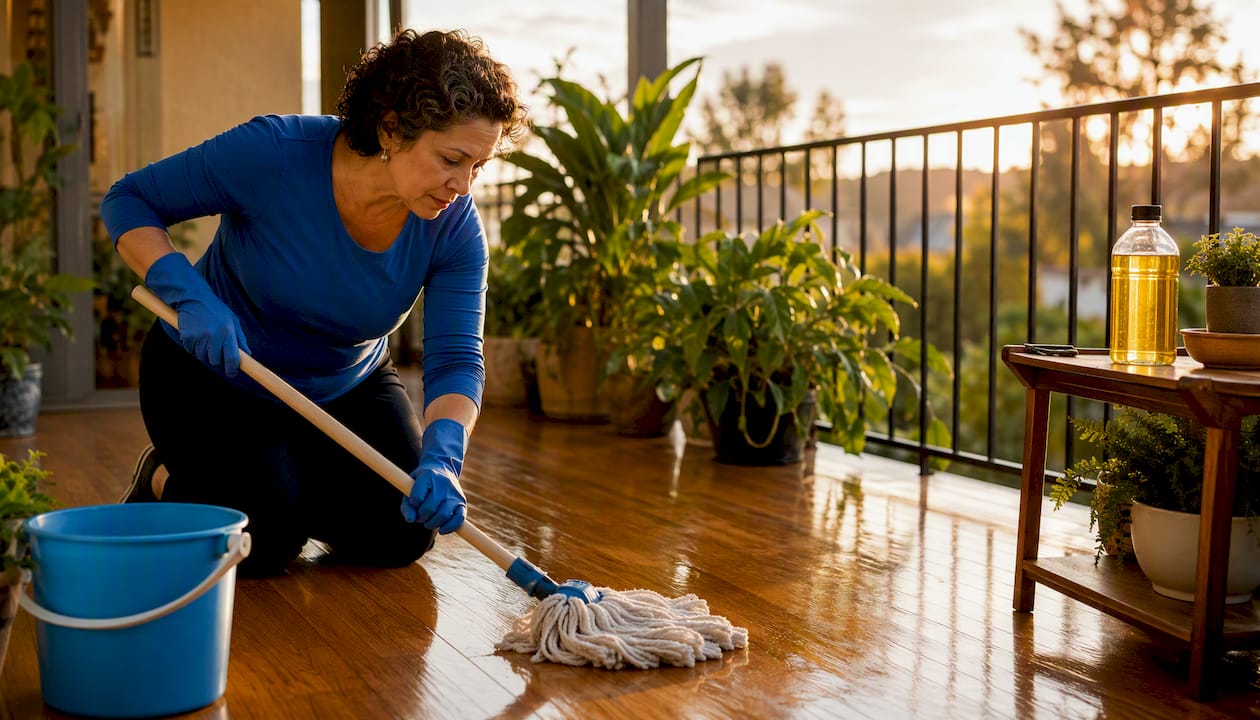
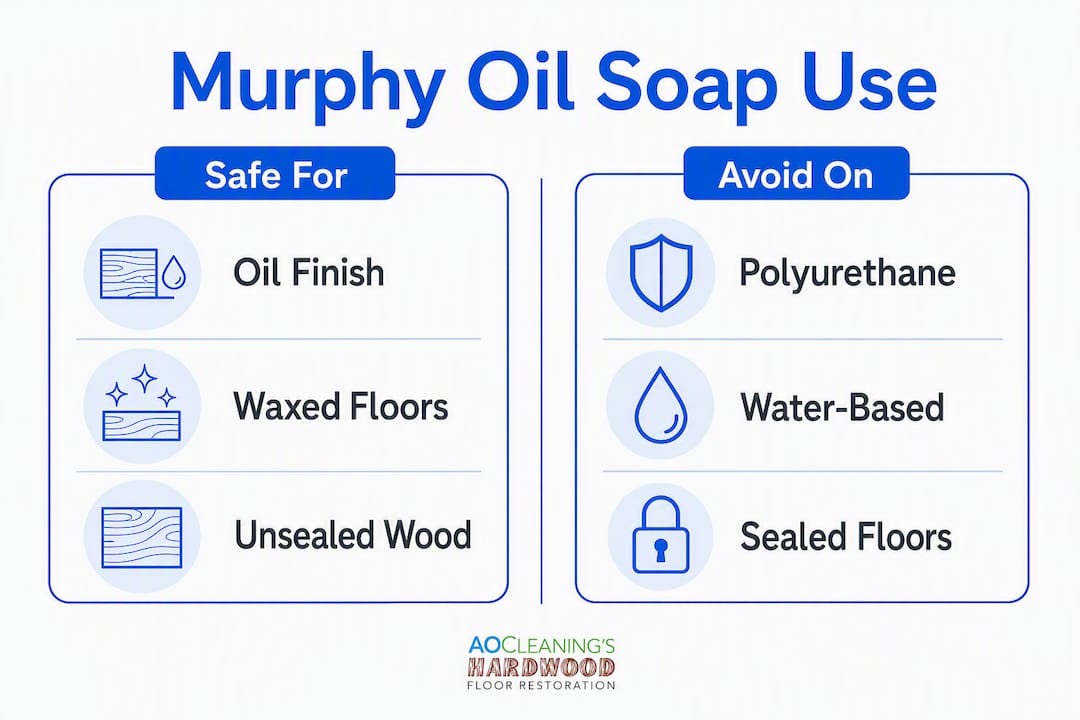
Murphy Oil Soap is generally not recommended for modern polyurethane or water-based finished hardwood floors — which covers the majority of homes in central Illinois and the St. Louis metro area. It may be appropriate for older oil-finished or waxed floors, but only with proper dilution, a spot test, and manufacturer sign-off.
When it may be OK: Oil-finished or waxed hardwood where the manufacturer’s guidance permits an oil-soap cleaner and you’ve confirmed compatibility with a spot test.
When to avoid it: Any sealed floor with a polyurethane or water-based finish. Trade reporting links oil-soap residue to up to 65% of recoat adhesion failures in commercial settings — a risk that applies equally in residential homes.
Next step: Do a water-bead test (drop water on the floor; if it beads, you have a sealed finish — avoid Murphy). Then do a spot test in a closet or low-traffic corner. If you’re still unsure, contact Aosaveswoodfloors for a quick compatibility check before you clean.
Table of Contents
What is Murphy Oil Soap, and why does it matter for hardwood?
Murphy Oil Soap is built on a potassium vegetable oil base, a formula that dates back more than a century as outlined in historical millwork and woodcraft resources like those at Gepetto Millworks. It was designed for wax-finished and oil-finished wood surfaces — the kind common in homes built before the 1970s. The oil lifts grime effectively on those surfaces because the chemistry matches: oil on oil.
The problem shows up on modern sealed floors. Plant-based oils don’t rinse cleanly off polyurethane or water-based finishes. They leave a thin oily film that changes how the surface feels and performs. Over time, that film builds up, dulling the sheen and making the floor feel tacky or slippery depending on foot traffic patterns.
There’s also a practical recoating issue. When a floor needs a fresh coat of finish, the surface has to be clean and chemically neutral. Oil residue interferes with adhesion, which is why flooring pros treat Murphy use as a red flag before any refinishing job.
Pro Tip: Before using any cleaner on your hardwood, pull up the manufacturer’s product label and, if available, the Safety Data Sheet (SDS). Both will tell you which finishes the product is formulated for — and which it isn’t.
The NWFA recommends using a cleaner matched specifically to your floor’s finish type, and warns against excess moisture and steam mops. Murphy’s label claims compatibility with all three finish types, but independent flooring professionals and D & G Flooring’s guide list oil soap as a damaging agent for surface-finished wood.
How Murphy behaves on different floor finishes
The finish on your floor determines everything. Here’s a quick decision guide:
Floor Finish | Murphy Compatible? | Key Risk | Recommended Action |
Polyurethane / water-based sealed | No | Residue buildup, recoat failure, slip risk | Use a pH-neutral cleaner |
Oil-finished hardwood | Possibly | Over-application can saturate wood | Spot test; follow manufacturer guidance |
Waxed hardwood | Possibly | Can strip or alter wax layer | Spot test; confirm with wax manufacturer |
Engineered hardwood | No (usually) | Surface finish is typically polyurethane | Treat as sealed; use pH-neutral cleaner |
Laminate / vinyl plank | No | Wrong surface chemistry entirely | Use laminate-specific cleaner only |
Unfinished / worn-through areas | No | Liquid absorbs into bare wood, causes swelling | Call a pro before cleaning |
Engineered hardwood trips up a lot of homeowners. The top layer looks and feels like solid wood, but the finish coating is almost always a factory-applied polyurethane. Murphy’s legacy marketing doesn’t account for that. If you’re not certain what finish you have, understanding why floors need different care by wood type is a good starting point before you reach for any cleaner.
How to use Murphy safely if your floor qualifies
If you’ve confirmed an oil-finished or waxed floor and your manufacturer permits oil-soap cleaners, follow these steps:
Use a nearly dry microfiber mop — Wring it out until it’s just barely damp to the touch. Standing water is the fastest way to damage any wood floor, sealed or not.
Pro Tip: Even if the spot test looks fine immediately after drying, check again the next morning in good light. Oil-soap haze sometimes takes several hours to fully develop — especially in humid conditions common to the St. Louis area in summer.
The NWFA’s maintenance guidance reinforces the same core technique: dust first, damp microfiber only, no standing water, full dry time before traffic.
What are safer alternatives for sealed hardwood floors?
For the vast majority of central Illinois and St. Louis homeowners with modern sealed floors, a pH-neutral, water-based hardwood cleaner is the right default. Consumer experts at Good Housekeeping and Bruce’s hardwood care guide both recommend purpose-designed hardwood cleaners over oil-based products or vinegar, which can dull finishes over time.
Here’s how Murphy compares to a pH-neutral cleaner on the dimensions that matter:
Dimension | Murphy Oil Soap | pH-Neutral Cleaner (e.g., AO Hardwood Neutral Cleaner) |
Safe finishes | Oil-finished, waxed | Polyurethane, water-based, oil-finished, engineered |
Residue / slip risk | Moderate to high on sealed floors | Minimal |
Dilution required | Yes (~1/4 cup per gallon) | Ready-to-use or light dilution |
Recommended frequency | Occasional only | Regular maintenance |
Rinse / film concern | Yes — film builds with repeated use | No film; residue-free formula |
Recoat compatibility | Risky on sealed floors | Compatible |
Aosaveswoodfloors carries the AO Hardwood Neutral Cleaner in both 32 oz and 1-gallon sizes — a locally tested option formulated for the sealed floors most common in this region. For homeowners who want a cleaner that won’t create problems before the next professional service, it’s a straightforward swap.
Residue-free formula means no buildup between professional visits
Compatible with polyurethane and water-based finishes
Available locally, so you’re not waiting on shipping when you need it
If you’re also thinking about the best cleaning products for hardwood floors more broadly, that guide covers the full range of options by finish type.
How to tell if Murphy has already damaged your finish
Some damage from oil-soap buildup is subtle at first. Watch for these signs:
Dull or hazy appearance that doesn’t improve after cleaning, especially in high-traffic paths
Tacky or slightly oily feel underfoot, even after the floor has dried
Slippery spots in areas that used to have normal traction. Oil residue can reduce the surface friction coefficient from the 0.5–0.6 range typical of dry polyurethane down to approximately 0.4, a meaningful slip-risk increase.
Patchy gloss where some areas look shinier than others
Finish peeling or flaking in high-traffic zones, often a sign that recoat adhesion has already been compromised
Pro Tip: If you notice haze or tackiness, don’t immediately apply more cleaner. A dry microfiber buff first can tell you whether the issue is surface residue or something deeper in the finish.
For light residue buildup, a clean-and-buff service can often restore the surface without full refinishing. If the finish has started to peel or adhesion has failed, a screen-and-recoat or full sand-and-refinish is usually the right call. Most Aosaveswoodfloors restoration services are completed in a single day, with floors ready to walk on in about three hours — so you’re not living around a construction zone for days.
Key Takeaways
Murphy Oil Soap is finish-dependent: it may work on oil-finished or waxed floors but creates real residue and recoat risks on the modern sealed hardwood found in most central Illinois and St. Louis homes.
Point | Details |
Murphy is finish-dependent | Safe only for oil-finished or waxed floors; avoid on polyurethane and water-based sealed hardwood. |
Do the water-bead test first | Water beading on your floor means it’s sealed — skip Murphy and use a pH-neutral cleaner instead. |
Residue risk is documented | Trade reporting links oil-soap residue to up to 65% of recoat adhesion failures in commercial settings. |
Prefer pH-neutral cleaners | Residue-free, manufacturer-compatible cleaners like AO Hardwood Neutral Cleaner are the safer default for modern floors. |
Aosaveswoodfloors can help | If you see haze, tackiness, or adhesion issues, Aosaveswoodfloors offers same-day restoration with walk-on time around three hours. |
A local pro’s honest take on Murphy Oil Soap
The question about Murphy Oil Soap comes up constantly, and it’s easy to see why. The product has been around for over a century, the label sounds reassuring, and it’s on the shelf at every grocery store in Belleville, O’Fallon, and St. Louis. But the floors in most homes built in the last 30 years are sealed with polyurethane or a water-based finish — and Murphy was never designed for those surfaces, regardless of what the marketing implies.
What I see in the field is a pattern: a homeowner uses Murphy for a year or two, the floor starts looking dull, and they assume the floor is just old. Often it isn’t. The finish is coated in oil residue that’s blocking the sheen and, critically, making the next recoat much harder to execute cleanly. That’s a real cost — not just aesthetically, but in the labor required to prep the surface properly before refinishing.
With 20+ years serving homeowners across central Illinois and the St. Louis metro area, and 450+ Google reviews from people who’ve been through exactly this situation, the advice from Aosaveswoodfloors is consistent: if your floor has a sealed finish, use a pH-neutral cleaner and save Murphy for the antique furniture it was originally designed for. If you’re not sure what finish you have, call before you clean — a quick assessment is far cheaper than a remediation job.
Restore your floors the right way with Aosaveswoodfloors
If Murphy Oil Soap has already left your floors looking dull, tacky, or uneven, the fix is usually faster than you think. Aosaveswoodfloors offers 1-day hardwood floor restoration for central Illinois and St. Louis homeowners — no multi-day disruption, no lingering odors, and floors you can walk on in about three hours.
Services include clean and buff, screen and recoat, full sand and refinishing, wax removal, and in-home consultations for homeowners who want a professional assessment before committing to a service. For ongoing maintenance, the AO Hardwood Neutral Cleaner is available in a 32 oz size for everyday use or a 1-gallon size for larger homes — both formulated for the sealed floors most common in this region. Call or book online to schedule your assessment. Before you refloor it, let Aosaveswoodfloors restore it.
Useful sources
Maintenance | National Wood Flooring Association (NWFA)
Is Murphy Oil Soap Good for Wood Floors? A Facility Guide — WipesBlog
How to Clean Hardwood Floors: The Complete Daily-to-Annual Guide — D & G Flooring
The Ultimate Guide to Hardwood Floor Care — Bruce
The Best Way to Clean Hardwood Floors, According to Experts — Good Housekeeping
AO Hardwood Neutral Cleaner (32 oz) — Aosaveswoodfloors
AO Hardwood Neutral Cleaner (1 gallon) — Aosaveswoodfloors
Note: The Murphy Oil Soap official SDS is available through the manufacturer’s website at murphyoilsoap.com. Adding the direct SDS link in the published version of this article is recommended for readers who want full ingredient and safety documentation.
Recommended

Comments