


St. Louis Homeowners: Demand HEPA and a 4 Inch Hose for Floor Sanding

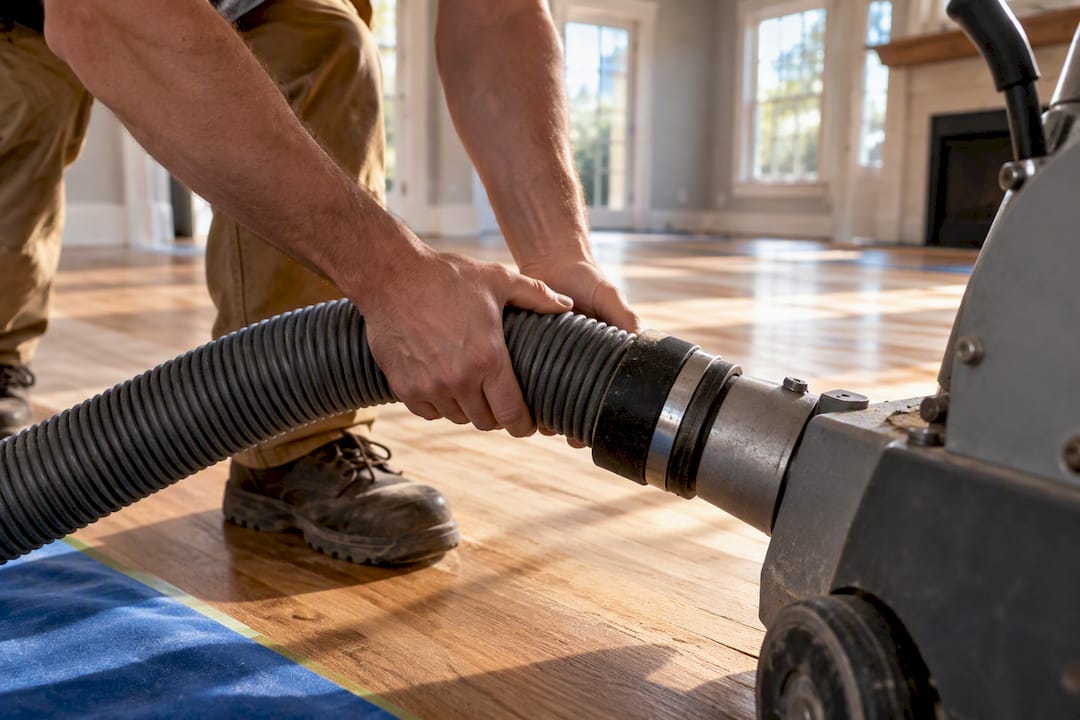
Dust containment sanding is available across the St. Louis metro, and it’s the right call for anyone living in the house during the work. Some companies run industrial vacuum extraction on every pass, which means a cleaner jobsite, less strain on anyone with allergies, and a smoother finish because dust never gets the chance to settle into wet coats.
TL;DR:
Dustless sanding in St. Louis typically costs 15 to 30 percent more than traditional methods, averaging $4 to $7 per square foot for basic jobs.
Using industrial-grade dust extractors with HEPA filtration and a 4-inch hose ensures cleaner air and better dust capture during sanding.
Most dust-contained floor jobs complete within a day, with floors walkable in about three hours, but full curing can take up to two weeks.
Homeowners should verify equipment specifics and review photos from previous occupied-house jobs to ensure contractor quality and effectiveness.
Proper preparation includes clearing furniture, covering HVAC vents, and waiting two weeks before placing rugs or heavy furniture back to prevent damage.
Table of Contents
What Does Dust Containment for Floor Sanding Look Like in St. Louis?
What Should You Ask a Floor Sanding Contractor Before Hiring?
How Long Does a Dust-Contained Sanding Job Take, and What Does It Cost?
How Should You Prepare Your Home Before and After the Crew Arrives?
Is Your Floor Sanding Contractor Licensed and Insured in St. Louis?
What Do St. Louis Homeowners Say About Local Sanding Contractors?
Do St. Louis Building Codes Address Dust Containment in Floor Sanding?
What Does Dust Containment for Floor Sanding Look Like in St. Louis?
A real dust-containment job follows a predictable rhythm. The crew arrives, seals off the work area from the rest of the house, and connects every sander to an industrial dust extractor before the first pass starts. Coarse sanding comes first to strip old finish, then medium and fine passes smooth the wood, with edge sanders along baseboards tied into the same vacuum line the whole time. Finish goes on last, and breakdown is fast because there’s no cloud of debris to sweep, bag, and haul out.
The equipment matters more than the marketing language around it. Ask about:
An industrial-grade dust extractor, not a household shop vacuum
A 4-inch hose diameter connecting the sander to the extractor
HEPA filtration on the exhaust side, not just the intake
Edge sanders wired into the same extraction system as the main sander
Aosaveswoodfloors builds this workflow into its 1-day hardwood floor restoration approach, along with screen-and-recoat jobs where a lighter touch still benefits from vacuum-connected equipment. A homeowner guide on the dustless sanding process walks through what that looks like room by room.
Does Dust Containment Actually Improve Finish Quality?
Yes, and the mechanism is simple. Dust that stays airborne during sanding eventually lands somewhere, and if it lands in a wet coat of finish, it embeds there permanently. Capturing that dust at the source before it settles gives you a smoother surface with fewer specks and less texture under your palm months later, a point Potomac Floors makes about finish consistency on dustless jobs.
Industry capture rates run 95 to 99 percent at the source, according to D and G Flooring’s guide to dustless refinishing, using industrial vacuums tied directly to the sanding equipment.
That’s a meaningful gap from zero, but it’s not the same as zero. “Dustless” is an industry shorthand, not a literal promise. A few realistic notes worth knowing before the crew shows up:
Edges and corners are the most common leak points, since hand sanders and edgers see the most airflow disruption.
Homeowners with occupied houses can typically stay in residence during the job rather than relocating for days, according to D and G Flooring.
Cleanup time drops dramatically because there’s no fine dust layer to wipe off every surface in adjoining rooms.
For households managing asthma, allergies, or a family member with respiratory sensitivity, that capture rate is the difference between a manageable week and a genuinely disruptive one.
What Should You Ask a Floor Sanding Contractor Before Hiring?
“Dustless” carries no formal certification or regulatory standard, which means the label alone tells you nothing about what equipment is actually running on your floor, a gap Potomac Floors flags directly. Here’s the order to ask questions in and what to look for in the answers.
What brand and model of dust extractor do you run? A vague answer (“we use a good vacuum”) is a warning sign. A specific brand and model means the contractor actually knows their equipment.
Is the exhaust HEPA-filtered, or just the intake? Some setups filter dust going into the machine but vent unfiltered air back into the room. Ask specifically about exhaust filtration.
What hose diameter connects the sander to the extractor? A 4-inch hose is the industry standard for adequate suction; anything narrower struggles to keep up with a drum sander’s output.
Is the edge sander tied into the same extraction system? Edges and corners are where most escaped dust originates, so a standalone edger with no vacuum connection defeats much of the purpose.
Can you show me photos from a recent occupied-home job? This is the single best proof point. Equipment lists sound good on paper, but photos of the actual setup in a lived-in house tell you whether the crew executes consistently.
Ask for references from occupied-home jobs specifically, not just any past client, and request an itemized quote that lists dust containment as a line item rather than a vague inclusion.
Pro Tip: If a contractor’s “dustless” quote doesn’t mention hose size or filtration at all, ask directly. A shop-vac connected to a sander is not the same equipment class as an industrial extractor, and the difference shows up in your air quality for days afterward.
How Long Does a Dust-Contained Sanding Job Take, and What Does It Cost?
Most single-room and whole-floor dustless jobs wrap in a day, with floors walkable within a few hours depending on the finish product used. Full cure, however, is a different clock entirely.
Setup and sanding: typically completed in one visit for standard-sized rooms
Walk-on time: often around 3 hours after the final coat, depending on finish chemistry
Full cure: can take up to two weeks before the floor is ready for rugs and heavy furniture
Wood Flooring Doctor recommends waiting up to two weeks before placing area rugs back down, even when the floor feels completely dry underfoot within hours.
On pricing, dust containment carries a real premium, and that’s worth budgeting for rather than treating as a surprise line item. Traditional sanding without vacuum extraction typically runs $3 to $5 per square foot, while dustless sand-and-finish work runs $4 to $7 per square foot, and premium jobs using water-based finishes can reach $6 to $9 per square foot, according to figures compiled by D and G Flooring. That works out to roughly 15 to 30 percent more than conventional sanding. The premium pays for the extraction equipment, the extra labor of managing hoses and containment during the job, and the cleanup time you’re no longer paying for afterward.
How Should You Prepare Your Home Before and After the Crew Arrives?
A little prep on your end makes the dust containment more effective, not less necessary. Before the crew arrives:
Clear rooms of furniture, rugs, and anything fragile that could be knocked during equipment setup.
Take down curtains and drapes near the work area, since fine dust can still cling to fabric even on a well-run job.
Turn off ceiling fans and central air circulation if your contractor advises it, since moving air can push residual dust further than a still room would.
Ask whether HVAC return vents in the work area should be covered, a step recommended in prep checklists from firms like Signature Custom Flooring.
After the finish goes on, the job isn’t over just because the floor looks dry. Wait the full two-week window before placing area rugs back down, and put felt pads under furniture legs the moment you move pieces back into the room. Some companies use eco-friendly finish products on restoration jobs, and most services are walkable in about 3 hours, but ask your crew directly what protective steps they recommend for your specific finish before you start moving furniture back in.
Pro Tip: Keep felt pads on hand before the job even starts. It’s easy to forget this step in the rush to get furniture back where it belongs, and scuffed new finish from bare chair legs is an entirely avoidable problem.
A related resource worth a look: One Day Doors & Closets covers low-dust practices for other trades working in occupied homes, useful if you’re coordinating floor work alongside other renovation projects.
Is Your Floor Sanding Contractor Licensed and Insured in St. Louis?
Missouri and Illinois both require general contractors to carry liability insurance, and most municipalities in the St. Louis metro require a local business license or permit registration for contractors performing work within city or county limits. Before signing anything, ask for proof of both general liability insurance and workers’ compensation coverage, and confirm the policy is active, not expired.
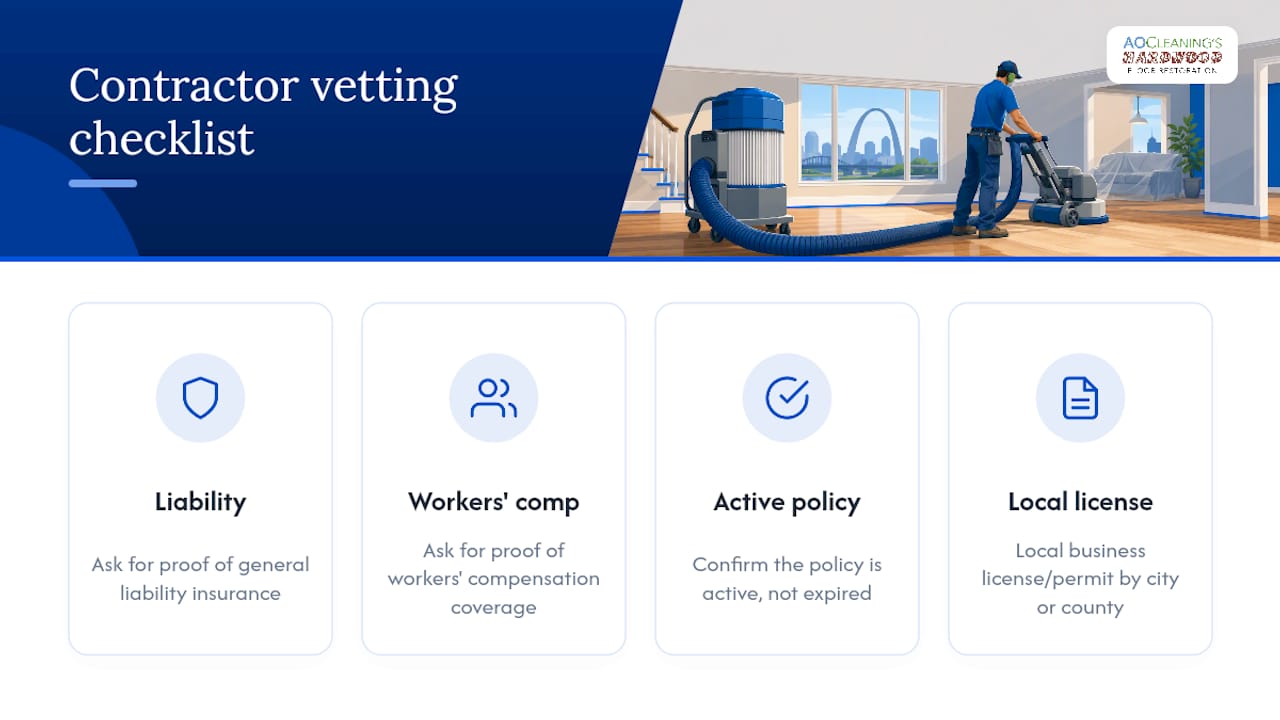
Licensing requirements vary by municipality. St. Louis City, St. Louis County, and Illinois counties like Madison and St. Clair each have their own registration processes, so a contractor operating across the metro area should be able to show credentials appropriate to wherever your home sits. A contractor without a clear answer about their coverage, or one who resists showing documentation, is a hiring risk regardless of how good their equipment sounds.
Insurance matters more on a floor sanding job than homeowners often realize, because the work involves industrial equipment, sealed rooms, and finish products with strong fumes during application. If a hose disconnects and floods a room with dust, or a finish reaction damages flooring, insurance is what separates a covered mistake from an out-of-pocket dispute. Ask specifically whether the policy covers property damage from equipment malfunction, not just general liability for injury.
A contractor operating for a long time in the region has typically worked through these local requirements enough times that the paperwork is second nature rather than an afterthought.
What Do St. Louis Homeowners Say About Local Sanding Contractors?
Google reviews are the most reliable signal available to homeowners vetting a local contractor, because they reflect real completed jobs rather than marketing copy. Some companies have built a track record of hundreds of Google reviews across their service areas, which span multiple counties including communities like Columbia, Belleville, Fairview Heights, Waterloo, and O’Fallon.
Volume matters, but so does consistency. A contractor with a handful of five-star reviews could simply have gotten lucky on a few jobs. A contractor with hundreds of reviews accumulated over 20-plus years has been tested across enough different homes, floor types, and finish choices that the pattern becomes meaningful rather than anecdotal.
When you’re reading reviews for any contractor, look past the star rating and read for specifics. Do reviewers mention dust, cleanup, or air quality after the job? Do they mention the crew’s punctuality and communication? Reviews that describe the actual experience of living through the sanding process, particularly from homeowners who stayed in their homes during the work, tell you more than a generic five-star rating ever will.
Do St. Louis Building Codes Address Dust Containment in Floor Sanding?
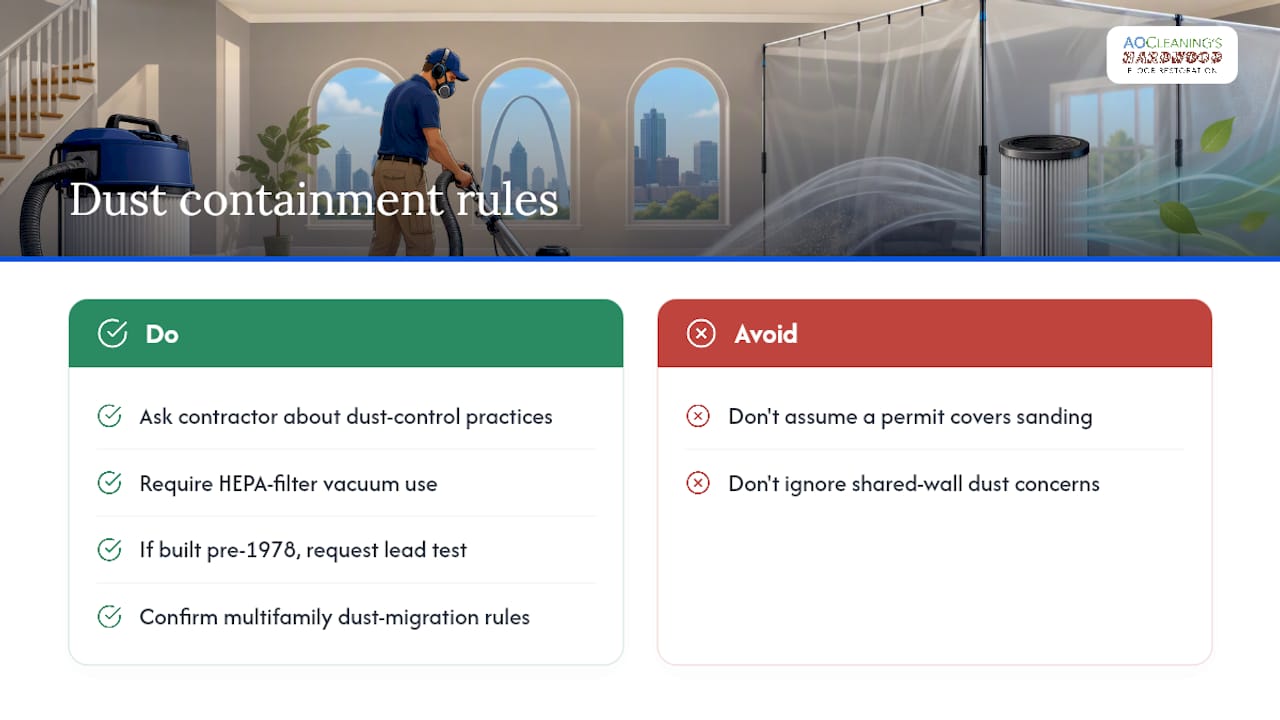
There’s no dedicated municipal code in the St. Louis area that specifically regulates dust containment for interior floor sanding, unlike exterior demolition or lead paint abatement, which fall under stricter EPA and local environmental rules. Floor sanding dust from wood and finish products isn’t classified the same way as lead-based paint dust, so homeowners shouldn’t expect a permit process specifically for a sanding job.
That said, general nuisance and property maintenance codes in most St. Louis-area municipalities do address dust migration between units in multifamily buildings or shared walls, which matters if you live in a condo, townhome, or duplex. If your home was built before 1978, ask your contractor whether lead testing is warranted before sanding begins, since older finish layers can contain lead-based products that require different handling entirely.
The absence of a dust-specific code doesn’t mean the standard is low. It means the burden falls on you to vet contractor practices directly rather than relying on a permit or inspection to guarantee quality. That’s exactly why the equipment questions in this guide matter more in St. Louis than they might in a city with stricter environmental permitting for interior renovation work.
What Contract Terms and Warranties Should You Expect?
A written contract for dust containment sanding should spell out dust containment as a specific line item, not a vague inclusion buried in the scope of work. Some contractors treat dust control as standard practice priced into every quote; others present it as a paid upgrade, a distinction worth clarifying before you sign anything, since assuming it’s included when it isn’t leads to unpleasant surprises on the final invoice.
Look for these terms specifically in any contract you’re handed:
Scope of work naming the extraction equipment and containment method, not just “dustless sanding”
Timeline with a stated start and completion date, plus what happens if weather or unforeseen floor damage extends the job
Finish warranty covering peeling, bubbling, or adhesion failure for a defined period after application
Cleanup responsibility stating explicitly what condition the crew leaves the space in in
A reasonable warranty on a full sand and refinish job typically covers finish defects for a period after completion, though exact terms vary by contractor and finish product used. Ask directly what’s covered and for how long, and get it in writing rather than taking a verbal assurance at face value. If a contractor hesitates to put warranty terms in writing, treat that hesitation as information.
A Local Perspective on Why Experience Changes the Outcome
Two decades of sanding floors in the same regional housing stock teaches a contractor things no equipment brochure can. Aosaveswoodfloors has worked across central Illinois and the St. Louis metro since 2003, building a base of more than 450 Google reviews across services from full sand and refinish to screen and recoat, all detailed on its service area page.
Here’s my honest read: dust containment is worth the premium specifically for occupied homes, allergy-sensitive households, and partial-room projects where the rest of the house stays in daily use. If you’re gutting a vacant property before resale, traditional sanding might be defensible. For everyone living in the house while the work happens, it isn’t a close call.
— Jim
Ready to Book a Dust-Contained Floor Sanding Job?
Aosaveswoodfloors is the local alternative to guessing whether “dustless” actually means dust-contained. Every job runs eco-friendly finish products and vacuum-connected sanding equipment as standard, not an upgrade, whether you’re booking a clean and buff refresh or a full sand, stain, and refinishing project.
Most restoration jobs finish in a single day, with floors walkable in about three hours, so you’re not living out of a suitcase for a week waiting on your living room floor. If your floors have old wax buildup instead of a worn finish, the wax removal service handles that separately before refinishing begins.
To get an accurate estimate, have your square footage, a few photos of the current floor condition, and a sense of which rooms are the priority ready when you reach out. Book an in-home consultation and a member of the team will walk the space, confirm the right service for your floor’s condition, and give you a real timeline before any work starts.
Sources
FAQ
Is Dustless Floor Sanding Available in St. Louis?
Yes, dustless and dust-containment sanding is offered by local providers including Aosaveswoodfloors, which uses vacuum-connected sanding equipment on full sand and refinishing jobs across the St. Louis metro. Coverage extends through St. Louis, Monroe, and Madison Counties.
How Much More Does Dustless Sanding Cost Than Traditional Sanding?
Dustless sanding typically runs 15 to 30 percent more than traditional methods, with traditional work at $3 to $5 per square foot versus $4 to $7 for dustless, according to D and G Flooring. Premium water-based finish jobs can run $6 to $9 per square foot.
How Soon Can I Walk on Floors After Sanding?
Most floors are walkable within about three hours after the final coat, but full cure takes longer. Wood Flooring Doctor recommends waiting up to two weeks before placing area rugs back down.
What Should I Ask Before Hiring a Dust Containment Contractor?
Ask about the extractor brand and model, whether the exhaust is HEPA-filtered, the hose diameter connecting sander to vacuum, and whether the edge sander ties into the same system. Request photos from a recent occupied-home job as proof, since equipment lists alone don’t confirm consistent execution.
Does Aosaveswoodfloors Offer Dust-Contained Sanding in St. Louis?
Yes, Aosaveswoodfloors builds vacuum-connected dust containment into its restoration services, including screen and recoat and full sand and refinish jobs. The company has served central Illinois and the St. Louis metro since 2003 with more than 450 Google reviews.
Recommended

Comments