


Hardwood Floor Abrasion Resistance: What It Means

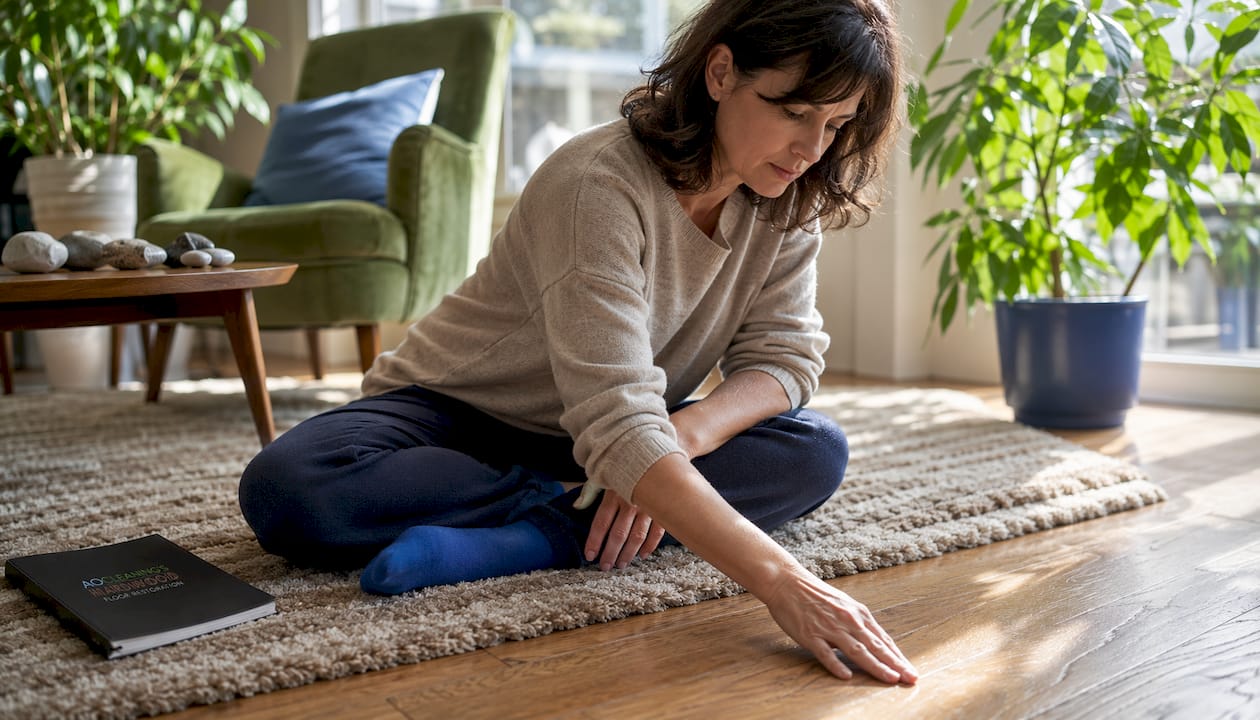
Hardwood floor abrasion resistance is how well your floor’s surface and finish hold up against being worn away by friction, grit, and repeated foot traffic. The bottom line: finish chemistry and maintenance matter more than species hardness for everyday wear. A softer species with a factory aluminum-oxide finish will often outlast a hard species with a thin, single-component coating.
When you’re comparing products, look for these on the spec sheet:
Taber abrasion test results (revolutions to Initial Point of wear, per ASTM D4060 or EN 15185)
Finish type (one-component vs. two-component, UV-cured, aluminum-oxide topcoat)
Wear-layer thickness (critical for engineered floors)
Table of Contents
What hardwood floor abrasion resistance actually looks like day to day
Abrasion resistance is the surface’s ability to resist being worn away by fine particles — dirt, grit, and dust — that act like sandpaper under every footstep and furniture movement. This is distinct from denting. A dent is a point impact that compresses wood fibers. Abrasion is a grinding process that removes material gradually, layer by layer.
Homeowners notice it as progressive dulling in traffic lanes, scuff rings near chairs, and eventually finish wearing through to bare wood grain. The damage is cumulative and easy to miss until it’s advanced. One thing most people don’t realize: the USDA Forest Products Laboratory found that wood at higher moisture content abrades more quickly, so humidity control isn’t just about warping — it directly affects wear rate.
Pro Tip: High-gloss finishes show micro-abrasions far sooner than satin or matte. If you have a busy household, a lower-sheen finish will look better longer between professional services — the scratches are just as real, but far less visible.
How the industry tests abrasion resistance
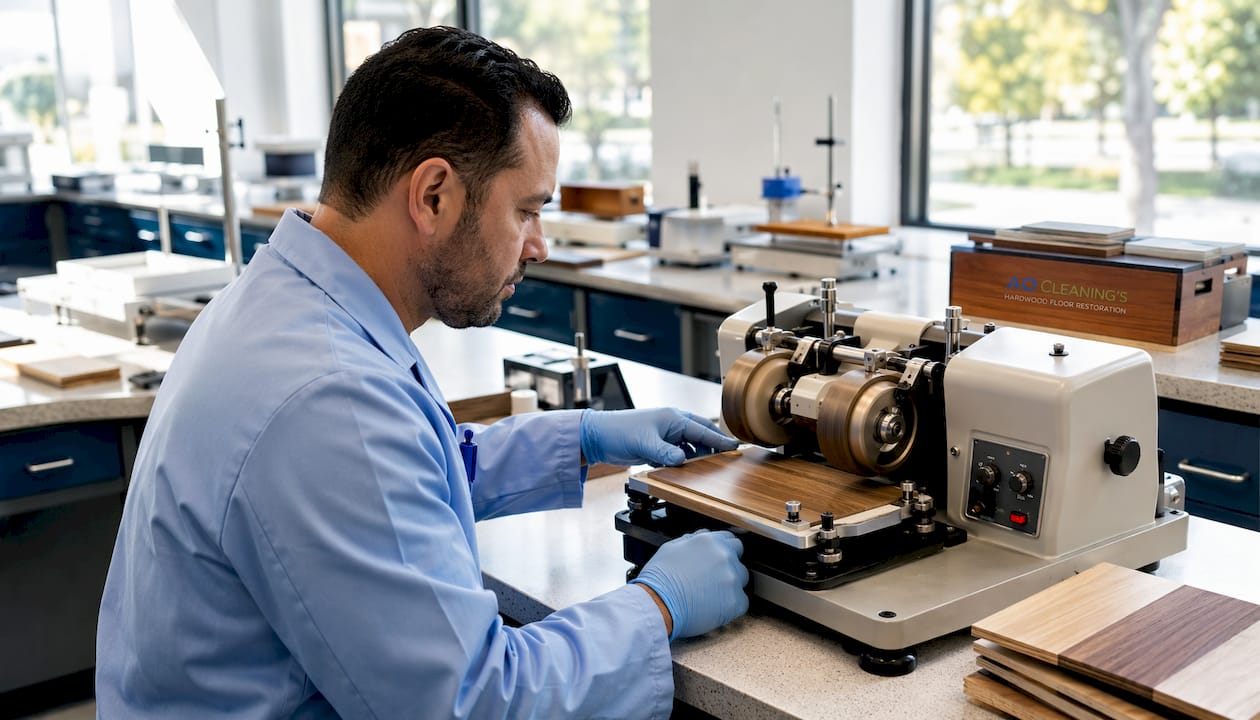
The standard method is Taber rotary platform abrasion testing, referenced in EN 15185 and ASTM D4060. A weighted abrasive wheel rotates against the coated surface, and technicians count the revolutions until the finish shows its Initial Point (IP) of wear. More revolutions to the Initial Point generally indicate better abrasion resistance.
Test Standard | What It Measures | What a Higher Result Means |
ASTM D4060 / Taber | Revolutions to Initial Point of wear on coated surface | Finish lasts longer under friction |
EN 15185 | IP of wear on laminate/wood flooring surface | Better surface durability rating |
— | Wear resistance of unfinished wood species | Species-level wear comparison |
Finish chemistry changes these results dramatically. Adding a topcoat increased revolutions to IP by 28% in one laboratory study. When you see a Taber result on a spec sheet, a number in the hundreds of revolutions is typical for a quality finish; anything under 100 should prompt questions about the coating system.
A 28% improvement in Taber revolutions from a single added topcoat shows how much finish decisions outweigh species selection for surface wear performance.
Abrasion resistance vs. Janka hardness: why you need both numbers
The National Wood Flooring Association is direct on this: Janka hardness measures compression resistance — how much force it takes to embed a steel ball into the wood. It predicts denting well. It does not predict finish wear.
What each metric tells you:
Janka hardness: Use it to evaluate dent resistance from dropped objects, pet nails, and heavy furniture legs.
Taber abrasion result: Use it to evaluate how the finished surface holds up under daily foot traffic and grit.
A concrete example: hickory has among the highest Janka hardness of common domestic species, yet USDA Forest Products Laboratory testing found it had higher thickness loss than ash, red oak, and white oak under abrasion testing. White oak, with lower hardness than hickory, showed the least wear. Species density and cell structure interact in ways that don’t follow a simple hardness ranking.
“Janka values give a general sense of how hard solid wood is, but other factors also contribute to the durability of wood as well. This can include things like how the wood is cut and the finish that is applied.” — National Wood Flooring Association
What actually drives abrasion resistance in real floors
Several variables interact, and finish chemistry sits at the top of the list.
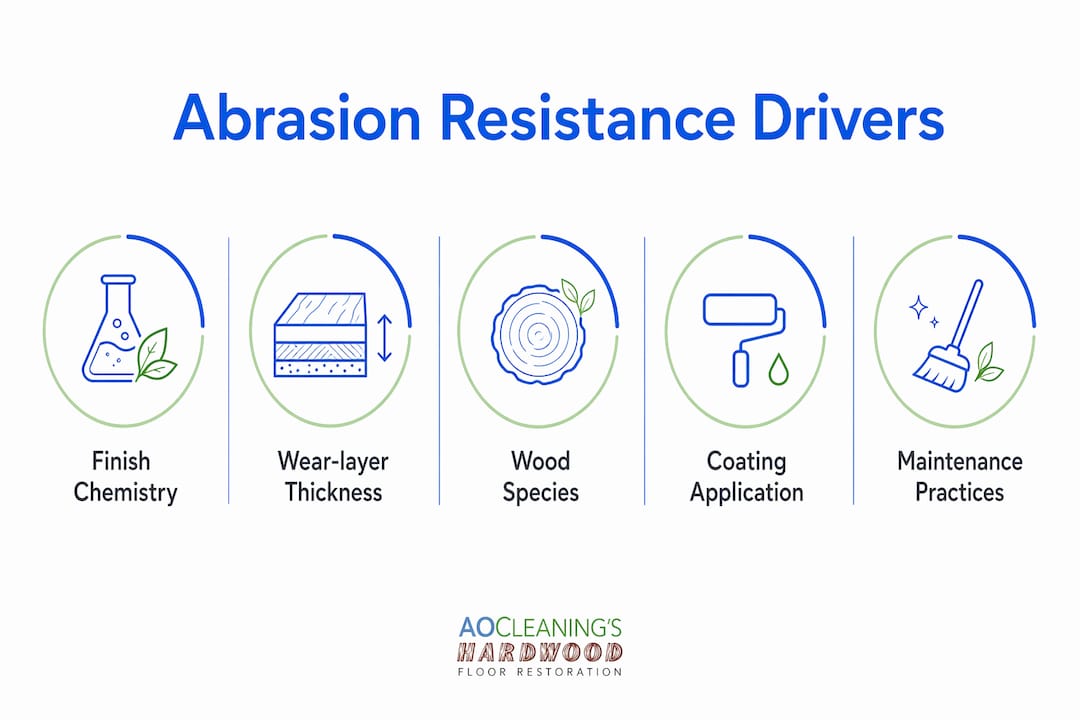
Finish type and application make the biggest difference. Two-component coatings deliver better tensile strength and abrasion results than single-component alternatives because of the chemical cross-linking that occurs during cure. UV-cured and aluminum-oxide factory finishes push performance further. Factory-applied finishes often incorporate aluminum oxide or similar inorganic abrasives directly into the topcoat, creating a surface that’s harder to wear through than most site-applied finishes.
Wear-layer thickness is the limiting factor on engineered floors. Once that layer is gone, refinishing isn’t possible. Thin wear layers (under 2mm) may allow only one or two light sandings before the floor is done.
Wood species and cell structure matter, but not in a straight line. The USDA FPL research showed that density influences abrasion, but ring-porous species with large differences between earlywood and latewood can behave unpredictably. Wood moisture content at 12% abraded faster than the same species at 6%.
Failure Mode | Primary Driver | Warning Sign |
Finish-driven wear | Weak coating chemistry, thin topcoat | Dulling in traffic lanes, finish peeling |
Species-driven wear | Low density, high moisture content | Fiber fuzzing, surface roughness |
Environmental wear | Humidity swings, grit accumulation | Accelerated dulling, edge cupping |
How to choose hardwood with abrasion resistance in mind
Shopping for hardwood floor durability means asking the right questions before you buy, not after installation.
Ask for documented Taber or ASTM D4060 test results, not just a Janka rating.
Confirm the finish type: two-component or UV-cured systems outperform single-component.
Count the factory finish layers; more layers generally mean better initial protection.
For engineered floors, get the exact wear-layer thickness in millimeters and ask how many refinishing cycles it supports.
Check the warranty language: does it cover finish wear specifically, or only manufacturing defects?
Match the product to your lifestyle. Pets, kids, and entryway exposure all accelerate abrasion.
For engineered vs. solid, the decision often comes down to refinishing windows. Solid hardwood can be sanded many times over decades. Engineered floors with thin wear layers may reach their limit in one refinishing cycle. Review finish types and their trade-offs before committing to a product.
Pro Tip: If you want a finish that hides daily wear between professional services, choose satin over semi-gloss. The sheen level affects how visible micro-abrasions are — satin is far more forgiving in high-traffic rooms.
Daily and seasonal maintenance that actually reduces abrasion
Grit is the enemy. Every grain of sand tracked in from outside acts as an abrasive under foot traffic. Removing it consistently is the single highest-return maintenance habit.
Daily: Dry dust with a microfiber mop or vacuum with a soft-brush head. Never use a beater-bar attachment — it scuffs the finish.
Weekly: Damp-mop with a neutral-pH hardwood cleaner. Avoid steam mops and wet mopping entirely; standing water accelerates wear and causes moisture damage.
Entryways: Place absorbent mats at every exterior door to trap grit before it reaches the floor. A two-mat system (one outside, one inside) catches far more than a single mat.
Furniture: Apply felt pads to all chair and table legs. Check them every few months — a worn-out pad with a grit particle embedded in it does more damage than no pad at all.
Seasonal: Control indoor humidity between 35–55% year-round. Humidity swings cause wood to expand and contract, which stresses the finish and accelerates surface wear.
Rugs: Use area rugs in high-traffic zones, but check underneath regularly. Trapped grit under a rug grinds against the finish with every step.
For a complete maintenance routine built around protecting your finish, Aosaveswoodfloors has detailed guidance for every floor type.
How to spot abrasion damage and decide what to do about it
The decision between a screen-and-recoat and a full sand-and-refinish comes down to how deep the damage goes.
Screen and recoat is the right call when you see fine dulling in traffic lanes, light scuff marks, or a finish that’s lost its sheen but hasn’t worn through to bare wood. This service scuffs the existing finish lightly, then applies a fresh topcoat. Screen-and-recoat services typically extend finish life significantly and are far less disruptive than a full refinish. Most floors benefit from this every 5–15 years depending on traffic and wear-layer thickness.
Full sand and refinish becomes necessary when scratches reach the wood itself, when finish adhesion has failed in patches, or when the wear layer on an engineered floor is approaching its limit. This is a more involved process that removes the top layer of wood entirely.
Pro Tip: Don’t wait until you see bare wood to schedule a recoat. Once the finish is gone, you’re abrading the wood itself — and on an engineered floor with a thin wear layer, that can mean the floor is unrefinable. Catching it at the “dull but intact” stage saves the floor.
A homeowner’s guide to what a recoat includes can help you understand what to expect before calling a pro.
How Aosaveswoodfloors assesses and restores floors in the field
Aosaveswoodfloors has been inspecting and restoring hardwood floors across the St. Louis metro and central Illinois since 2003, with 450+ Google reviews built on consistent results. When a technician walks a floor, the assessment focuses on finish condition first: is the sheen uniform, are there wear-through spots, and does the finish still adhere cleanly?
When a floor comes in looking “just dull,” it’s almost always a finish problem, not a wood problem. A screen and recoat at the right time costs a fraction of a full refinish and adds years of life. The mistake most homeowners make is waiting until they can see the wood grain.
Most Aosaveswoodfloors restoration jobs complete in a single day, with floors ready to walk on in roughly three hours. Dustless techniques mean no fine-particle mess left behind. For floors that need more than a recoat, the full refinishing process restores the surface to factory-fresh condition.
Pro Tip: Schedule a professional inspection every 3–5 years even if your floors look fine. Finish wear is gradual — a pro can spot the early signs of abrasion damage before it becomes a costly repair.
Key Takeaways
Finish chemistry and proactive maintenance determine how long your hardwood floor surface holds up — species hardness alone is not a reliable predictor of abrasion resistance.
Point | Details |
Finish beats species | Two-component and aluminum-oxide factory finishes outperform weak coatings on even the hardest wood. |
Test results matter | Ask for Taber or ASTM D4060 results; An improvement from one added topcoat shows how much finish decisions matter. |
Grit control is highest ROI | Daily microfiber dusting and entryway mats remove the abrasive particles that cause most finish wear. |
Recoat before wear-through | Screen and recoat every 5–15 years; waiting until bare wood is visible risks irreversible damage on thin wear layers. |
Aosaveswoodfloors | Provides single-day screen-and-recoat and full refinishing services across the St. Louis metro and central Illinois. |
The finish is the floor
Most homeowners spend hours comparing species hardness ratings and almost no time asking about finish chemistry. That’s backwards. The finish is what your feet, furniture, and grit actually contact every day. The wood underneath matters, but it’s largely protected — or not — by what’s on top of it.
The other thing worth saying plainly: engineered floors have a hard stop. Once the wear layer is gone, no amount of professional skill brings it back. The refinishing window is finite, and every unnecessary abrasion cycle shortens it. A consistent maintenance routine and a timely recoat aren’t optional extras — they’re what determines whether a floor lasts 25 years or 75.
Your floors don’t have to look worn out
If your hardwood floors are showing signs of abrasion — dulling, scuffs, or finish loss in traffic lanes — Aosaveswoodfloors offers professional inspection, screen-and-recoat services, and full refinishing across St. Louis, Monroe, and Madison Counties. Most jobs finish in a single day, with floors walkable in about three hours, using dustless equipment and eco-friendly products throughout.
For daily maintenance between professional visits, the AO Hardwood Neutral Cleaner is a pH-neutral formula safe for all finished hardwood. Call Aosaveswoodfloors to schedule an inspection or get an estimate — before you refloor it, let them restore it.
Useful sources and further reading
USDA Forest Products Laboratory — Wear Resistance and Hardness of Five US Hardwoods: Species-level abrasion and Janka data; explains why density and cell structure don’t always predict wear in a straight line.
National Wood Flooring Association — Durability: Guidance on Janka hardness, finish factors, and what actually drives long-term floor performance.
MDPI Coatings — Interactions of Coating and Wood Flooring Surface System Properties: Taber abrasion methodology, EN/ASTM standards, and finish chemistry findings including the 28% topcoat improvement.
MDPI Forests — Abrasion Resistance in Low-Density Plantation Timber for Engineered Flooring: Why abrasion testing is more reliable than Janka for engineered products with thin wear layers.
Aosaveswoodfloors — Hardwood Floor Maintenance Best Practices: Practical cleaning and care routines for homeowners maintaining finished hardwood.
Recommended

Comments